Organizational Updates
This Is Your Industry. Be Part of What Comes Next.
Outfitters are fiercely independent. It’s part of what makes this industry special. But right now, the challenges facing outdoor businesses are too big to tackle alone.
America Outdoors is where outfitters come together—to protect access, strengthen their businesses, learn from people who understand the work, and make sure our industry has a voice when decisions are being made.
Your membership connects you to:
- A stronger voice on permitting, public lands, workforce policy, liability, and the issues shaping your future.
- People who get it—a national community of outfitters willing to share hard-earned knowledge, ideas, and support.
- Resources built for this industry—from risk management and insurance to business education, member savings, and direct access to experts.
- A seat at the table as we fight for a stronger future for outfitting and outdoor recreation.
This is a critical time for our industry. The more of us who stand together, the harder we are to ignore.
If you believe outfitting is worth protecting—and that the best future is one we build together—join us or renew today.

A Bittersweet Farewell to Kim
At the end of July, Kim Thomas will retire after years of quietly holding the America Outdoors office together. Her family has been encouraging her to make the move for some time, and she has finally decided it’s time for this next chapter. We are incredibly grateful for Kim and the care, dedication, and steady hand she has brought to AO. She has always gone above and beyond to make sure nothing slipped through the net, and the conference will certainly hit differently without her running registration and keeping everything moving. Kim will be deeply missed, but we couldn’t be happier for her as she steps into retirement. If you’d like to send her well wishes, she’ll be monitoring [email protected] through the end of July. Thank you, Kim, for everything you’ve done for AO, our members, and this community. We wish you all the very best in the chapter ahead.
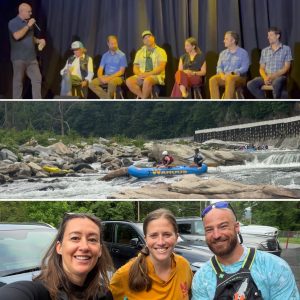
Caryn recently spent time with outfitters and industry partners in Tennessee, where it was encouraging to see commercial rafting back on the Nolichucky and operations on the Pigeon River continuing to recover after Hurricane Helene. She joined Wahoo’s on the Nolichucky alongside Ruthie Rivers of Granite Insurance and Paul Wingfield of Outfitter Marketing Pros, and was honored to participate in NORA’s (Nolichucky Outdoor Recreation Association) community event in Erwin. The trip also included time with Pigeon River outfitters and longtime AO leaders David and Robin Brown, who continue to generously support our team and help preserve the history that has shaped the association. We’re grateful for the opportunity to see and connect with the people behind these businesses and witness firsthand the resilience and community that continue to define this industry.
Federal Land Management
Forest Service Public Comment Notice on Proposed Rule to Modernize Directives
The Forest Service published a proposed rule on July 1, 2026, that would restructure the agency’s Directive System by making certain changes to how the Forest Service Manual and Forest Service Handbooks are treated (Forest-Service-Public-Comment-Notice-on-Proposed-Rule-to-Modernize-Directives.pdf). Under the proposed rule, the Manual would become the “sole source of continuing, mandatory direction” (in addition to applicable statutory law and regulation), though agency officials would retain discretion, to the extent permitted by law, to depart from that direction when an alternate action is deemed to be in the public interest and the justification is documented. The Handbooks—including FSH 2709.11, which governs special-use authorizations, permit terms, cost recovery, and outfitter and guide conditions—would be reclassified as advisory and informational guidance that employees may deviate from without documenting or justifying an alternative action.
This shift toward greater agency discretion cuts both ways for permit holders. On one hand, added flexibility could work in an outfitter’s favor. For example, a district office might be more willing to accommodate a late renewal, adjust an operating plan mid-season, or work through a documentation gap without triggering a formal Handbook amendment. On the other hand, that same flexibility means an office could just as easily depart from the cost-recovery methodology, fee calculations, or renewal timelines that FSH 2709.11 currently lays out, without the documentation the binding Manual requires, leaving permit holders with less certainty in exactly the areas, fees, renewals, and operational terms, that most directly affect their business. Because Handbook provisions would no longer carry mandatory weight, permit holders would have less basis to hold the agency to a consistent standard when those decisions cut against them.
The rule also narrows when the agency is required to provide public notice before changing its directives. Federal law requires the Secretary of Agriculture, by regulation, to establish procedures, including public hearings where appropriate, to give the public notice and an opportunity to comment on “the formulation of standards, criteria, and guidelines applicable to Forest Service programs.” The proposed rule would clarify that, because all such standards, criteria, and guidelines would be codified in the Manual, only the initial round of Handbook revisions would go through notice and comment; subsequent Handbook changes would not be subject to notice-and-comment requirements. Additionally, under the proposed rule, the removal or rescission of any directive, even from the Manual, would not be considered “formulation” and therefore would not require notice-and-comment either.
The agency specifically invites comments identifying which Handbook provisions the public believes should be moved into the Code of Federal Regulations to preserve their enforceable status. For outfitters, that is a direct invitation to identify which FSH 2709.11 permit administration provisions (e.g., fee structures, renewal criteria, denial or termination procedures, comment-submission timeframes, or operational constraints) recreation service providers believe should be codified rather than left as advisory guidance subject to agency employee discretion.
Comments are due July 31, 2026, by mail or through regulations.gov (search RIN 0596–AD74). Contact: [email protected] or 202-205-1464.
Forest-Service-Public-Comment-Notice-on-Proposed-Rule-to-Modernize-Directives.pdf
BLM Opens Its Entire Wilderness Rulebook—Four Dockets, One August Deadline
This applies primarily to BLM permittees running trips in or next to designated wilderness, wilderness study areas, or lands managed for wilderness characteristics. On June 15 the BLM published four Federal Register notices that together put its wilderness management policy back on the table. Three are open-ended reviews of Manual 6340 (Designated Wilderness, docket BLM-2026-0067), Manual 6330 (Wilderness Study Areas, BLM-2026-0069), and Manual 6320 (Lands with Wilderness Characteristics, BLM-2026-0068). They ask whether updates are appropriate but propose no text. The fourth is a substantive draft that would revise Manual 6340 to bring in the EXPLORE Act’s PARC climbing provisions, covering fixed anchors and the casual-use line for commercial services (BLM-2026-0034). All four close August 14, 2026.
None of the three open-ended notices mention commercial services, outfitters, or guides, nor much else in specific. If commercial outfitting in wilderness is to be addressed in the resulting manuals, the operating community must ensure its interests are represented in the official record.
The provisions that matter most to outfitters are already identifiable. The “extent necessary” test in Manual 6340 decides whether any commercial service can operate in BLM wilderness, and the current language names packers, outfitters, and guides by name and ties necessity to what visitors are actually able to do on their own. This language currently protects existing commercial services and is a key point for consideration during the comment period. A separate provision in the same manual reads as an automatic bar on categorical exclusions for any action that authorizes a commercial service, which would sweep in a routine outfitter renewal that has no meaningful effect on wilderness character, forcing an environmental assessment where none is warranted. The Forest Service runs a cause-and-effect significance test instead. The rulemaking process provides an opportunity to advocate for alignment with the Forest Service model.
There is also a gap worth flagging in comments in how BLM is conforming its rules to the EXPLORE Act. The climbing docket updates Manual 6340 to match the law’s treatment of fixed anchors, but the filming and photography provisions have not been updated to reflect the EXPLORE Act’s handling of filming that happens incidentally on an authorized outfitting trip. AO plans to work all four dockets as a single coordinated comment package. Members with BLM wilderness operations, WSA permits, or guided climbing programs should contact us with any operating specifics that may warrant specific inclusion or consideration for the record before August 14.
Two Utah Travel Plans Open for Comment This Month; a Third on the Horizon
This is for BLM special recreation permit holders in the Kanab, Vernal, and Moab field office areas. On June 22 the BLM released comment documents for two Utah travel management plans and preliminary alternatives for a third. Between them the plans cover a lot of ground and a lot of routes, and the first two deadlines land in the next three weeks.
The Trail Canyon plan out of the Kanab Field Office covers roughly 326,000 acres and 469 route miles in Kane County, including corridors near Coral Pink Sand Dunes, the Parunuweap Canyon and Moquith Mountain WSAs, and ground adjacent to Zion. The alternatives range from about 326 open route miles at the low end to 446 at the high end, so the outcome genuinely moves the network you can run. Comments are due July 22, 2026, by email to [email protected], and there is a public meeting July 9 from 6 to 8 p.m. at the Kanab Center, 20 N. 100 E., Kanab. If you hold a Kane County permit, that meeting is worth the drive.
The Dinosaur North plan out of the Vernal Field Office covers roughly 345,000 acres and 700 route miles in Uintah and Daggett Counties, along the Green River corridor near Dinosaur National Monument, through Browns Park, and across the Diamond Mountain country. This one reaches river outfitters, hunting guides, and 4WD operators directly; the alternatives run from about 285 available OHV miles to 694. Comments are due July 23, 2026, to the BLM Vernal Field Office, Attn: Dinosaur North TMP, 170 South 500 East, Vernal, UT 84078.
One point applies to both plans: a general commercial authorization does not automatically carry your route access forward. Access to a specific route has to be confirmed in the plan language and in your permit terms, and a closure can undercut the commercial viability of an operation even when the SRP itself stays valid. The third plan, Dolores River out of the Moab Field Office (about 127,000 acres and 321 route miles in Grand County), is in preliminary-alternatives review only. No comment period is open yet; a draft environmental assessment is expected in fall or winter. Moab-area operators should pull the preliminary maps off BLM ePlanning now so they are not reading them cold when the EA drops. Members who want help drafting comments or coordinating a member comment coalition can reach us at AO.
Interagency Council Releases the Section 133 Visitation Pilot Framework
This one reaches every permitted outfitter and guide, on lands managed by the NPS, BLM, Fish and Wildlife Service, Forest Service, NOAA marine sanctuaries, and the Army Corps. In June the Federal Interagency Council on Outdoor Recreation published its implementation report for EXPLORE Act Section 133, laying out the pilot protocols agencies will use to measure recreation use—including the dispersed, low-use activity that ordinary traffic counters and visitor surveys miss. The pilots mix on-the-ground counting with newer sources: mobile-device location data, automated counters, acoustic sensors, game cameras, permit records, and social media analytics. The report is honest that mobile-device data alone is not accurate for dispersed recreation and needs more testing before anyone leans on it.
This methodology directly impacts the data used to authorize, expand, or hold commercial service allocations. If a pilot undercounts backcountry hunting, off-season paddle trips, or stock use, the demand picture tilts toward the frontcountry, and an area that looks like it has no unmet demand is an area an agency has less reason to keep outfitter allocations in. A 30-day comment period is open through July 29, 2026, on both the protocols and the pilot locations, through BLM’s ePlanning portal. If you run dispersed BLM country, scenic rivers, or complex multi-access parks, this is the moment to tell the agencies whether their counting methods actually capture your use, because that data may inform a renewal or allocation decision later.
Comment portal (Participate Now): https://eplanning.blm.gov/Project-Home/?id=3240C41B-9A70-F111-AB0D-001DD8084607
Fed Register notice: https://www.federalregister.gov/documents/2026/06/29/2026-13095/notice-of-public-comments-on-section-133-of-the-expanding-public-lands-outdoor-recreation
Visitation report we cite: https://ridb.recreation.gov/download
Unified Regulatory Agenda
The updated Unified Regulatory Agenda is the federal government’s semiannual ‘to-do list’ of regulations that agencies are working on or planning across the Executive Branch. It doesn’t change any rules by itself, but it shows what the Forest Service, BLM, and National Park Service are actively developing next, including proposals on the Roadless Rule, travel management, cost recovery, recreation permitting, and bicycle use in parks. We’re flagging these items so America Outdoors members can see what’s in the pipeline and be ready to engage as formal proposals are released.
Forest Service
Roadless Rule Conservation Repeal (RIN 0596-AD66): https://www.reginfo.gov/public/do/eAgendaViewRule?pubId=202510&RIN=0596-AD66
Project-Level Predecisional Administrative Review Process (RIN 0596-AD69): https://www.reginfo.gov/public/do/eAgendaViewRule?pubId=202510&RIN=0596-AD69
Travel Management Repeal and Revision (RIN 0596-AD70): https://www.reginfo.gov/public/do/eAgendaViewRule?pubId=202510&RIN=0596-AD70
Directives Modernization (RIN 0596-AD74): https://www.reginfo.gov/public/do/eAgendaViewRule?pubId=202510&RIN=0596-AD74
Special Uses Cost Recovery (RIN 0596-AD35): https://www.reginfo.gov/public/do/eAgendaViewRule?pubId=202510&RIN=0596-AD35
BLM
Special Recreation Permitting (RIN 1004-AF56): https://www.reginfo.gov/public/do/eAgendaViewRule?pubId=202510&RIN=1004-AF56
Rescission of Conservation and Landscape Health Rule (RIN 1004-AF03): https://www.reginfo.gov/public/do/eAgendaViewRule?pubId=202510&RIN=1004-AF03
Zero-Based Regulating (RIN 1004-AF36): https://www.reginfo.gov/public/do/eAgendaViewRule?pubId=202510&RIN=1004-AF36
NPS
Bicycle Use in Park Areas (RIN 1024-AE97): https://www.reginfo.gov/public/do/eAgendaViewRule?pubId=202510&RIN=1024-AE97
Congress and Federal Legislation
CRA Lawsuit in Oregon Tests How Far the Logic Goes
Environmental groups filed suit last week over a timber sale in western Oregon, pressing the same theory some raised on the Hill when Congress first deployed the Congressional Review Act against BLM Resource Management Plans last year: any plan adopted since the CRA became law in 1996 and never formally submitted to Congress as a “rule” may be legally vulnerable, along with every permit, lease, and access decision built on top of it.
The specific dispute involves the Aloha Trout Forest Management Project, a 1,305-acre timber sale authorized under the Northwestern and Coastal Oregon Resource Management Plan. Cascadia Wildlands, represented by Silvix Resources, argues that BLM is offering timber for sale without a valid underlying plan because Congress has already established—through its CRA rescissions of other plans—that RMPs are “rules” that must be submitted to Congress. Lawmakers recently used the CRA to void Biden-era plans in Alaska, Montana, Wyoming, and North Dakota, and most recently to undo mining limits near the Boundary Waters. Conservation groups are now running that same argument in the other direction.
The lawsuit asks the court to declare the underlying 2016 plan void because it was never submitted under CRA procedures. A ruling on that question would affect BLM’s authority going forward; it would not invalidate existing permits overnight. Agencies continue to administer active plans during litigation, and permittees have independent legal standing. The structural risk is the precedent itself. If judges accept that RMPs are subject to CRA review, the legal foundation for new permits, renewals, and plan amendments across the BLM system becomes less predictable. Recreation access designations, SRP structures, and permitted corridors on BLM land—most of them governed by plans finalized since 1996—would share the same underlying vulnerability. Silvix principal Susan Jane Brown has framed the suit as Congress reaping what it sowed.
We’ve been tracking this structural problem since Congress first applied the CRA to BLM plans in late 2025. Our position hasn’t changed: the issue is not any specific plan, but that using the CRA against multi-year planning documents introduces volatility outfitters and land managers cannot plan around. A statutory fix—clarifying that FLPMA and NFMA land-use plans are not subject to CRA rescission—remains an appropriate solution, and one we have floated to lawmakers. We are monitoring this litigation and will flag any developments that create on-the-ground impacts for members.
Legacy Restoration Fund Reauthorization Clears Committee in Both Chambers
For outfitters whose operating areas depend on federal trail, road, campground, or boat-ramp maintenance: On June 24 the House Natural Resources Committee reported the Great American Outdoors Act 250 (H.R. 9250) favorably to the full House by voice vote, adopting an amendment in the nature of a substitute. On the Senate side, the Energy and Natural Resources Committee advanced its companion, the America the Beautiful Act (S. 1547), earlier in the month. Both bills reauthorize the Legacy Restoration Fund—the House version renames it America’s Legacy Restoration Fund—at roughly $1.9 billion a year, directed at the deferred-maintenance backlog across federal public lands.
The money splits about 70 percent to the Park Service and 15 percent to the Forest Service, with smaller shares to Fish and Wildlife, BLM, and the Bureau of Indian Education. For working outfitters, the Forest Service share is the one that reaches you—it funds the trail repairs, road maintenance, campground work, and boat launches that determine whether you can get to your operating area. The BLM share is smaller but covers the corridors outside the park system where a lot of SRP holders run. Both bills also carry the per-region access-project pilot we described on June 15: up to 15 percent of each agency’s share goes to at least two recreation or sportsmen’s-access projects per region per year, which pushes maintenance toward the access points guests actually use rather than only the marquee corridors.
Two things are new since June 15. First, both bills now codify the foreign-visitor fee structure—a surcharge of at least $100 per person at parks that charge entrance fees, plus a foreign-visitor annual pass of at least $250. An amendment to strip that provision was raised in the House markup and rejected, so it stays in the reported text. Operators with significant international clientele should keep their foreign-visitor pricing and pass disclosures clearly documented; if this becomes law, the fee moves from administrative practice into statute. Second, the current Legacy Restoration Fund expires September 30, 2026, which is the clock driving both floor scheduling and the eventual reconciliation between the House and Senate versions. The bills differ on dollar amounts and duration and will have to be squared before anything reaches the President.
ORG Act Lands in the Senate
On June 18, Senator Steve Daines (R-MT) introduced S. 4838, the Outdoor Recreational Outfitting and Guiding Act—the Senate companion to Representative Burgess Owens’s H.R. 3499, which has been sitting with the House Education and Workforce Committee. The Senate bill was read twice and referred to the Committee on Health, Education, Labor, and Pensions.
If enacted, S. 4838 would add a new exemption under Section 13(a) of the Fair Labor Standards Act for employees primarily engaged in outdoor recreational outfitting (including equipment rental) or guiding services, provided they work for an employer whose principal business is providing those services. That is the full-exemption framework AO has been advocating for since last year.
The mismatch this fixes is familiar to anyone who has tried to run a trip-based business inside a forty-hour week. The FLSA overtime trigger was built for fixed schedules and factory floors, not for work that swings from zero hours to sixty-hour weeks with the season, runs on multi-day expeditions where a guide cannot leave mid-canyon, and turns on weather and river flows rather than a clock. The current framework forces operators to cap guide hours, hire extra staff simply to spread shifts, shorten itineraries, or move operations off federal lands entirely.
This is a classification adjustment, not a pay cut. Congress has long granted comparable exemptions to ski areas, seasonal amusement parks, youth camps, and marinas, all similarly situated industries where traditional hourly models do not fit real-world conditions. Workers’ compensation, OSHA, and state wage-and-hour laws remain fully in effect; the bill simply removes a federal hourly framework that never aligned with our kind of work.
What this is right now is draft text that AO and our coalition partners can shape during HELP Committee review. We are coordinating with the Daines office to keep the bill on track for markup and to build the bipartisan support it will need to move. If you have questions about how the exemption would apply to your operation or want to weigh in on our committee strategy, call us at AO.
Recreation Permitting Improvement Act Gets a Subcommittee Hearing
H.R. 9248, the Recreation Permitting Improvement Act, had its first hearing before the House Natural Resources Subcommittee on Federal Lands on July 1. Sponsored by Rep. Jeff Hurd (R-CO) with Rep. Christopher DeLuzio (D-PA), the bill would add “recreation infrastructure” to the FAST-41 permitting program created in the FAST Act, giving qualifying projects a lead agency, coordinated NEPA timelines, and a public dashboard.
For most outfitters, this is a watch item, not an immediate operational change. Routine special use permits will still run through existing Forest Service and BLM frameworks, not FAST-41. The bill would matter where you see multi-agency NEPA bogging down capital work (trailheads, access roads, boat launches, campgrounds, marinas, and large route or trail systems that need coordinated review by multiple federal agencies).
The Subcommittee Chair framed the bill as building on FAST-41’s success and tied it to the $1.3 trillion outdoor recreation economy and over 5 million jobs. The ranking member backed better recreation access but questioned whether adding recreation to FAST-41 is the right tool versus simply resourcing land agencies. Blue Ribbon Coalition’s Ben Burr stressed that the bill does not change environmental laws; it creates a more predictable, time-bound process for complex recreation infrastructure projects similar to what other sectors already have.
Labor and Hiring
H-2B First-Half FY2027 Filing Window Opens July 3
For any outfitter who staffs fall, hunting, or shoulder-season operations with H-2B workers, this is the operative deadline. The Office of Foreign Labor Certification issued a reminder on June 26 that the three-day window to file H-2B applications requesting an October 1, 2026 start date opens July 3 at 12:00 a.m. Eastern and closes July 5 at 11:59 p.m. Eastern. October 1 is the first day of the 33,000-visa first-half allotment for FY2027. Applications requesting an October 1 start that are filed before the window opens will be denied; those filed inside the window are randomly ordered for analyst assignment.
No FY2027 supplemental visa allocation has been announced. Because H-2B compliance turns on individual filing facts and deadlines, an employer with questions about its own situation should confirm specifics with its immigration counsel.
Deadlines and Action Items
July 1: Most America Outdoors memberships renew.
July 3–5: Filing window for first-half FY2027 H-2B applications (October 1, 2026 start dates).
July 9: Trail Canyon TMP public meeting, 6:00–8:00 p.m., Kanab Center, 20 N. 100 E., Kanab, UT.
July 22: Comments due on the Utah Trail Canyon TMP (Kanab Field Office); email [email protected].
July 23: Comments due on the Utah Dinosaur North TMP (Vernal Field Office).
July 31: Comments due on the Forest Service Directives proposed rule (RIN 0596-AD74); regulations.gov or [email protected].
August 14: Comments due on all four BLM wilderness dockets: Manual 6340 (BLM-2026-0067), Manual 6330 (BLM-2026-0069), Manual 6320 (BLM-2026-0068), and the recreational climbing guidance (BLM-2026-0034).
September 15: Petition deadline for the third FY2026 supplemental H-2B allocation.
Fall/winter 2026: Draft environmental assessment expected for the Utah Dolores River TMP (Moab Field Office); monitor BLM ePlanning.